
My Eyes - "Day By Day" available now!
A cassette release of their debut EP and re-launch of MeatCube

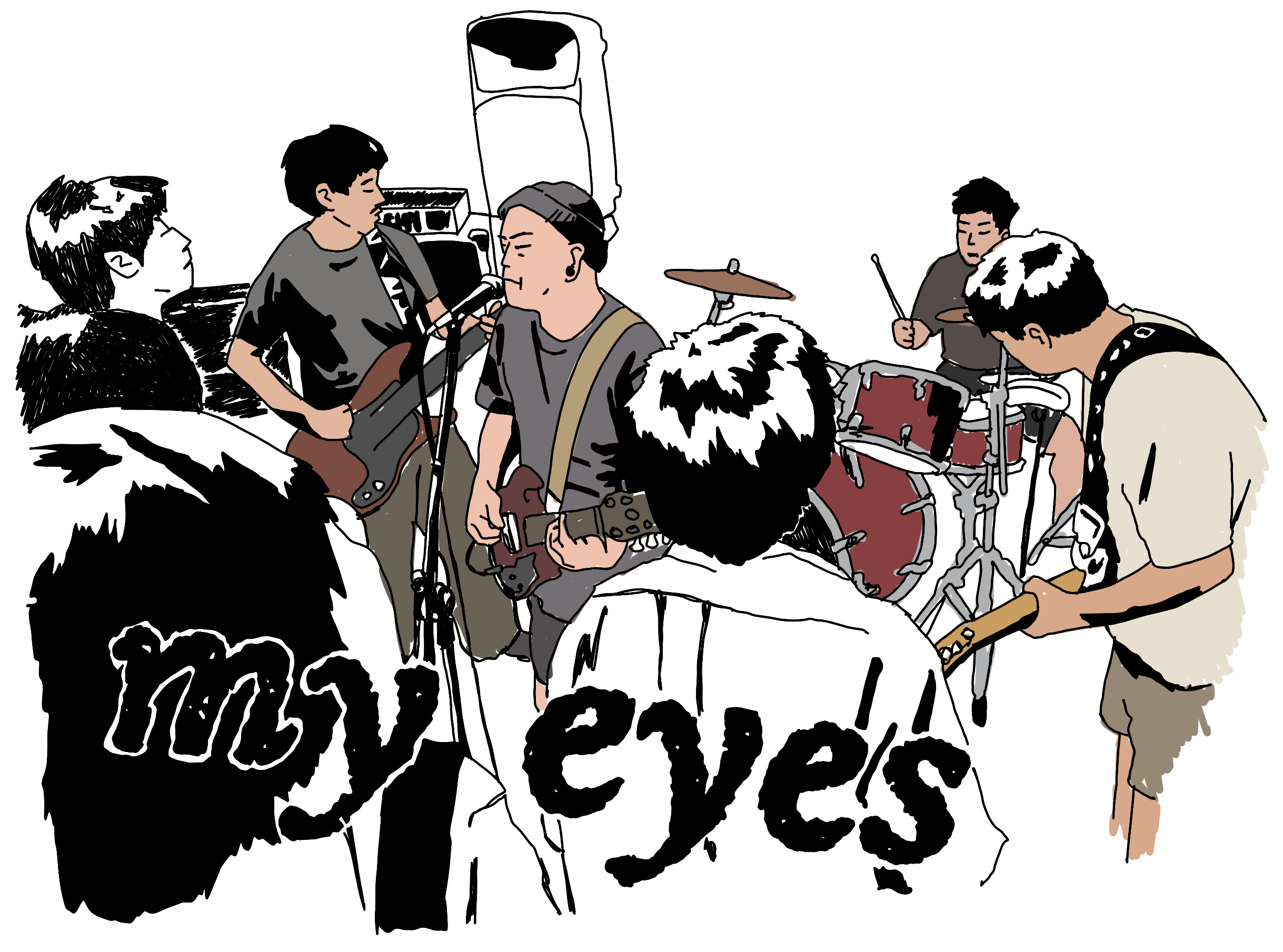
At the end of a 2023 interview with Dignity For All, frontman Nobuyuki Fujiyama said “I think it would be good to start a new band with these members”. This was on the eve of a reunion show more than 20 years after Dignity For All disbanded. It seems that getting back together with old friends had reignited the chemistry the four members felt.
Roughly a year after that, my eyes was announced; a new band with the original members of Dignity For All. They wanted to explore a style not too far from the original group, but decidedly more in the post-hardcore and screamo vein.
I watched the group develop from afar, excited to hear their new songs. Then, last September, I got to see them play in Nagoya during a trip to Japan. The experience was incredible. So much energy and passion. It was also my first chance to hear their full set. After the show, I got a bunch of copies of their debut 7” to sell in the store.
But after coming home from that inspiring trip, I wanted to start the label up again. I knew that the my eyes debut was one of the first releases I wanted to put out.
Over the last few months, I’ve been hand-printing and assembling the cassette boxes. I had rubber stamps molded at Casey Rubber Stamps. Then hand-stamped each side of the box with a white pigment inkpad. The top and bottom flap are also embossed with my label name, and I colored in each heart with a paint marker (Uni Posca). Finally, I printed the booklets at home, cut the pages to size, and stitched them together. All in all, I think I performed 20 actions to assemble each tape! I’m really proud of it and I hope you love the result.
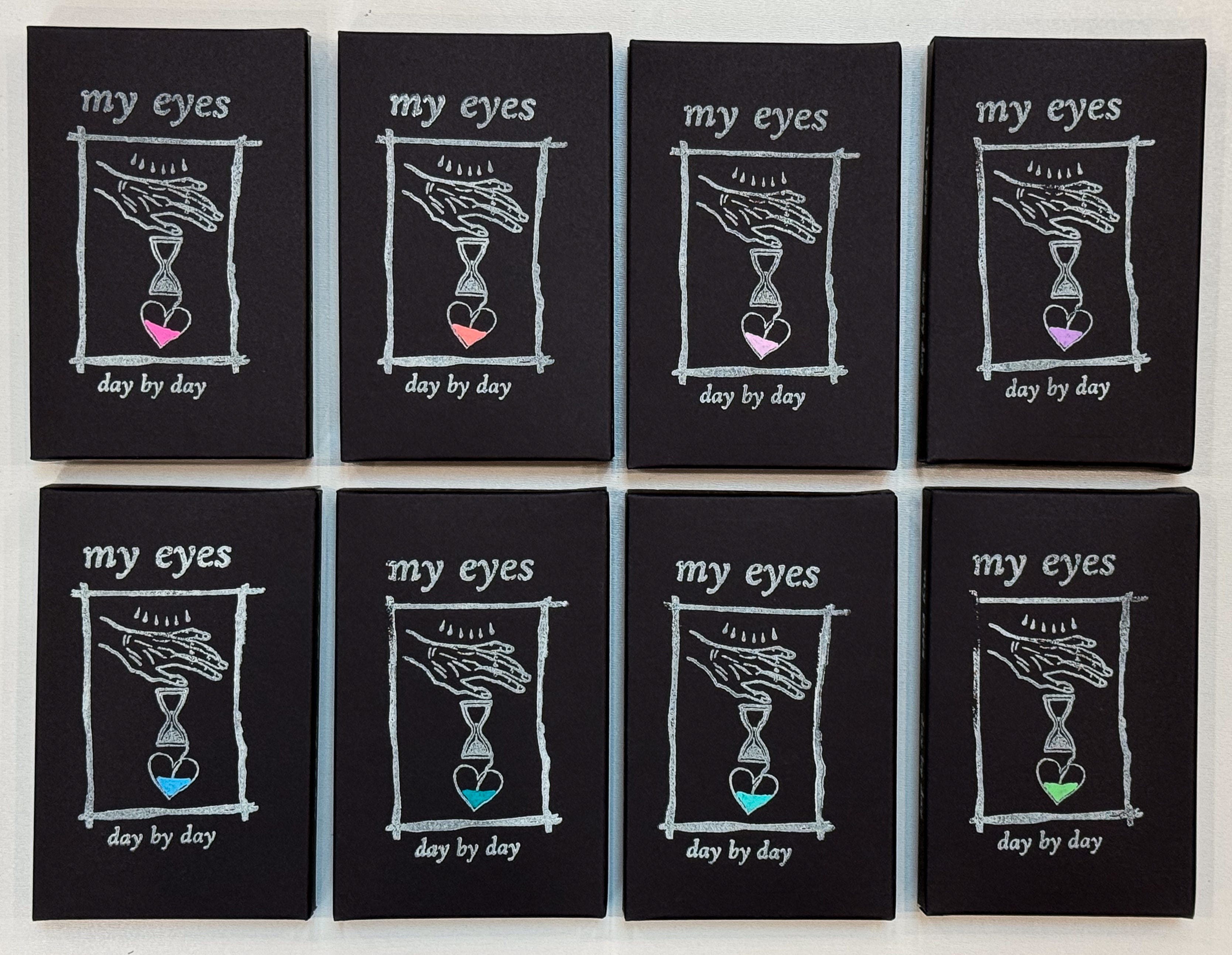
The cassette is available to purchase from my online store, or Bandcamp. I made 100, but only kept 70 (30 will be going to the band if you want to get them from them in Japan).
In celebration of this release, I also want to share a translation of the interview the band gave last year. This was presented in a zine included in the 7” version. I thought it provided a really fun look into the band’s motivations and how this EP came to be. Enjoy!
Interview by Rufen Publishings
Thank you for taking the time to speak with us. First, could you please introduce all the members? A brief introduction is fine, but I’d also like to hear about your past activities.
Manabu Gotō: I’m Gotō, guitarist. I joined the band Dignity For All—the predecessor to this band—around 1996, and around the same time I also started a small label called Soul Ameria Records. After that, I joined a band called Mouko Tokkyuu, and since then I haven’t really belonged to any bands that properly took shape.
Nobuyuki Fujiyama: I’m Fujiyama, vocals and guitar. In the past I’ve been involved with FACE OF CHANGE, dignity for all, ANMA, Next Style, BORED TO DEATH, nothing, nothing.nothing!, CUT BACK, OUT, among others. Currently, I’m also playing drums in NO REST.
Ikuya Terui: I’m Terui on drums. In the past, I was a long-time member of a band called theSun. I was also active in NEXT STYLE and Dignity For All. Additionally, although only for short periods, I was also a member of bands such as DISCOTORTION and ANMA.
Yuji Ishiyama: I’m on bass. Nice to meet you. I’m originally from Sapporo and currently live in Chitose. Within band circles, I go by the nickname “Gotchi.” The only member who calls me “Ishiyama-san” is Gotō (since we originally met through work). I was born in 1973, and when I was in high school, the band boom was at its absolute peak.
When I was a second-year high school student, I was invited by a classmate who played bass, and we formed a band called Exterminate Storm (literally “Annihilation Storm”—youth really is something, isn’t it). We did covers of Napalm Death and SOB.
My entry point into hardcore was grindcore and Japcore. I borrowed a bass from the Exterminate Storm bassist to play, but the band ended after just one show. The following year, I formed a US hardcore band for a school festival and took on vocal duties. We played Minor Threat, Gorilla Biscuits, 7 Seconds, and also a local band called Spit Fire.
The last song we played was “Sink With California” by Youth Brigade.
It’s a great memory—just one page of my youth. We also played a few shows at live houses.
After that, in my early twenties, Fujiyama-kun invited me to join a new band, and I joined Dignity For All. Around that time, I felt like I was listening to a wide range of bands. In my late twenties, I left the band due to work and moving, among other reasons.
That was the end of my band career.
Please tell us about the circumstances behind forming the band, as well as your motivations and thoughts on its direction. Personally, I sometimes wonder how many more times in my life I’ll get the chance to start something new.
Gotō: In November 2023, there was a one-night-only reunion show for Dignity For All, and all of us started going into the studio together around August or September. We played old songs and also wrote just one new song. Personally, as we kept playing with people who shared similar tastes and sensibilities, it naturally became fun, and I think I timidly asked something like, “Should we try continuing?”
Fujiyama: As for forming my eyes, it started along the lines of what Gotō-kun described above, but we had no intention of doing it as Dignity For All. If we were going to play new songs, then it should be as a new band—that’s why we started my eyes. I’ve continued band activities in various bands for a long time, so the idea of once again playing old songs just didn’t make sense to me.
The Dignity For All reunion show was done as part of a charity project called “ALIVE!” that I was running at the time with OUT. Even then, I felt we shouldn’t just play old songs—we should at least write and play one new song.
In your question, you mention, “how many more times in life will we get to start something new,” but for me, there are still countless things I want to do. The only question is how much of that I can do within the limited time I have left.
Gotō: That’s true. I don’t know whether my eyes will still be around ten years from now, but I still want to keep expressing something. It might sound dramatic, but I feel like this EP has allowed us to leave behind a small trace of having lived. I want to be able to give form to the things I feel like doing, whenever that feeling arises.
Ishiyama: After leaving the band, I almost completely stopped going to live houses, and around the time Doll magazine folded—maybe a little before or after that—my interest in the scene gradually faded. I also lost contact with most of the members.
Then, out of the blue, Gotō-kun reached out about a reunion. The act of “starting something new” was exactly what made me hesitate. Among the members, I was the one who struggled the longest to make a decision. But Terui, for example, seemed unexpectedly enthusiastic, and in the end I felt like I was being pushed forward by a majority vote. That’s how I decided to get involved again.
Now, I’m grateful to all the members who reached out and invited me.
The four songs on the EP have a wide range of riff moods and song developments, and it felt like you were first spreading out the band’s full set of cards. How was the songwriting done, and roughly how much time did it take? Also, were there any cultural references you drew from when creating the songs (not limited to bands or music)?
Fujiyama: Sometimes each member brings in riffs and we shape them into a song together, then keep changing things from there. Other times, one person writes an entire song on their own. I think that’s probably where the wide range of moods comes from. There are riffs that I would never think of myself, after all.
As for the songs I bring in, I’m an old-school person to begin with, so there may be aspects that haven’t really changed from back then. And now I sometimes think, maybe that actually feels fresh?
As a vague image of what we wanted to do, there’s this idea of wanting to be a band that might have been included on Tree Records’ compilation “eucalyptus.”
Gotō: Indian Summer, Boilermaker, Julia—that sort of thing. Falling Forward, Policy of 3, Four Hundred Years, Shotmaker, Fugazi as well. Since all of us have those bands in our background, I think it naturally ends up sounding like the ’90s. And the punk spirit—the DNA—of emo and hardcore bands from that era is also something that still serves as an emotional anchor for us.
Where and over what period of time was the recording done, and how did the process go? Were there any moments that left a strong impression during recording?
Fujiyama: When it came to the sound, time was limited, so we approached it with the idea of somehow getting everything recorded in one day. The studio we used was one I’d also used for recordings with OUT and NO REST, so I already knew how things worked there and could more or less estimate what was possible. I think this is true for any band, but after you finish recording and some time passes, you always start thinking, “We should’ve done this a little differently…” and various issues come up.
Terui: It was one day. We recorded at a rehearsal studio in Sapporo called Studio MIX, asking them to handle it as a recording session. Fujiyama-kun had recorded other bands there before, so that’s how we decided on it. We asked the studio staff to handle engineering as well.
Since we could record each part separately, we tracked the drums while also recording the other parts at the same time, then used the good takes. Because it was analog, we were able to get a nice kind of roughness, which was good. Of course, ideas like “We should try this next time” came up too—I guess that’s for the next release.
Ishiyama: This year saw record-breaking heat across the country, and even Sapporo on the day of recording was so hot it made you wonder, “Is this really Hokkaido?” We met on Sunday morning, finished earlier than scheduled, and then the four of us went to see a live show together. I remember the venue being full of trapped heat and humidity—it was extremely uncomfortable. I think Fujiyama and Gotō-kun might have gone on to another show at a different venue afterward.
Gotō: That’s right. We went to Revolver in Maruyama. I left the house at 8 a.m. that day, recording wrapped up around 6 p.m., then we watched a show, then another show—and I think I got home around 2 a.m. It was an incredible day.
I’d like to ask why you chose to release this as a 7-inch. Personally, I feel this format really suits the band, but pressing records seems to require a lot of time and money. How do you think about the necessity of leaving something in a physical form?
Fujiyama: It might simply be that I wanted to listen to my own band on analog. Physical formats are probably hard to sell, and records in particular might not be something people today really need. But by including a download code, even people without a record player can still listen.
There were a lot of twists and turns in deciding on a pressing plant, and we handled all the communication and production ourselves. By doing everything on our own, we learned a lot—both the good parts and the bad. In the end, I felt that it all comes down to people. Even when we contacted major analog pressing companies, sometimes we didn’t even get a reply. Our pressing numbers weren’t that large either, but I’m very grateful to the people who sincerely communicated with us regardless.
Gotō: Records are expensive to make! (laughs)
That said, for someone like me who grew up with records, they’re incredibly appealing. It’s not something you can just make happen through passion alone, but once Fujiyama-san brought up the idea, we all spent a lot of time thinking it through together. Going forward, I’d love to do things like releasing splits with other bands as well.
What is the current situation of the scene surrounding the band like? Hokkaido feels too broad to lump together, so are there any bands or movements around you that you’re particularly paying attention to right now?
Fujiyama: Among the members, I’m probably the one who goes to see live shows the most, and I think what you gain from that is immeasurable. When you interact with all kinds of people across different genres and different places, you’re constantly reminded that there are truly incredible people out there.
In terms of the overall situation, I think things are actually really good right now. There are many live houses, many bands, and I feel the level across the board is high. There are also lots of people and bands working hard on putting together shows, and the scene feels very active.
The problem is that Sapporo isn’t very big. Good shows often overlap, and audiences end up split—that happens quite a lot. As someone who regularly goes out to shows, that’s a frustrating issue. If you ask me which bands I’d recommend, it’s honestly hard to answer, but I feel like no matter which live house you go to on a weekend, there’s usually a good band playing.
Ishiyama: When I was a teenager, bands like Bloodthirsty Butchers, Eastern Youth, and Slang were really active, and when I experienced their live shows back then, I thought, “These people are amazing.” Then a few years later, I realized, “They really were incredible people!”—which surprised me quite a lot.
In today’s Sapporo scene as well, there are many bands that give me that same feeling, so I’m looking forward to what comes next. I don’t know much about what’s happening in other regions, but the Sapporo scene has always been kind of genre-mixed, and that’s something I especially like. I think that’s thanks to the generations that came before us.
Gotō: I don’t get out to live shows as much as Fujiyama-san does, so it’s hard for me to really talk about the scene, but as my eyes we’ve been organizing shows ourselves, so maybe we’re involved—just a little—in helping keep things active? Well, we still have a long way to go, though (laughs).
People who can keep both bands and show-organizing going consistently are really impressive. It makes me strongly realize that to do anything, you need light footwork and a good sense of momentum. And like Ishiyama-san said, without the people who came before us, we wouldn’t be anything at all.
If you have any particular preferences or philosophies regarding the gear you use, please tell us (the more detailed the better—I’d personally be very happy!).
Gotō: I don’t think I’m that particular about gear (laughs). I play a Telecaster Thinline, and for pedals I use a Green Monster and a Zoom pedal-type multi-effect. Ideally, I’d like to do everything with just one distortion pedal, like Braid, but I probably don’t have the technical skill to pull that off (laughs).
Fujiyama: My approach to gear… maybe having no real attachment is my attachment. I’ve said this to the members and people around me before, but I just don’t really feel the necessity. Distortion and clean tones are enough. That’s only in the context of the bands I play in, though. Ideally, just a footswitch to change between distorted and clean sounds on the amp would be fine.
But amps vary depending on the venue, so for that reason I use a cheap overdrive pedal, just in case. I like the idea of showing up anywhere, plugging in quickly, blasting through the set, and heading out right away. I think that’s cooler.
Terui: My snare is a copper Yamaha snare, about 25 years old. It’s not an overly strong or aggressive sound, but I really like the sustain. The way it rings feels almost like a natural reverb, which I like a lot. On this recording, I probably shaved off a little too much of that sustain, so that’s something to revisit next time.
Other than that, I don’t really use any unusual pedals or gear. I guess the only thing worth mentioning is that I keep a tambourine in my setup and use it for accents.
Lastly, could you each leave us with a final comment?
Terui: I’m glad it turned into a release that really feels like my eyes. I’d love to go play shows in Tokyo and elsewhere during a cooler season.
Fujiyama: For me personally, this record carries a lot of meaning in various ways—things like the title “day by day”, and the meaning behind the jacket artwork as well. This band isn’t dignity for all, but I think this is a work where you can feel that same lineage continuing from the past.
There are things we couldn’t do back then that we can do now, and of course the reverse is also true. Everyone will hear it, see it, and feel it differently, but I hope that through this release, people can each find something about themselves as they go on living.
That said, I haven’t really found anything myself yet—I’ve just gotten older. But I hope this release can become some kind of trigger or starting point for something.
Ishiyama: “I am not afraid of death; I just don’t want to be there when it happens”—that might be an ideal, but for aging band guys, it’s more like: we don’t die, we just keep playing live shows. Please let us keep going a little while longer.
Gotō: With this release as a starting point, I want to go to lots of different places, even overseas. There are so many things I want to do, and I hope to gradually make them happen through my eyes.
Thank you very much for interviewing us.
already ordered a cassette ! awesome